
Pricing model to redistribute demand in urban transport
Paraná case
DOI:
https://doi.org/10.64876/radi.v26.5Keywords:
Time-based management, economic incentives, stochastic simulation, urban mobility, fare planning.Abstract
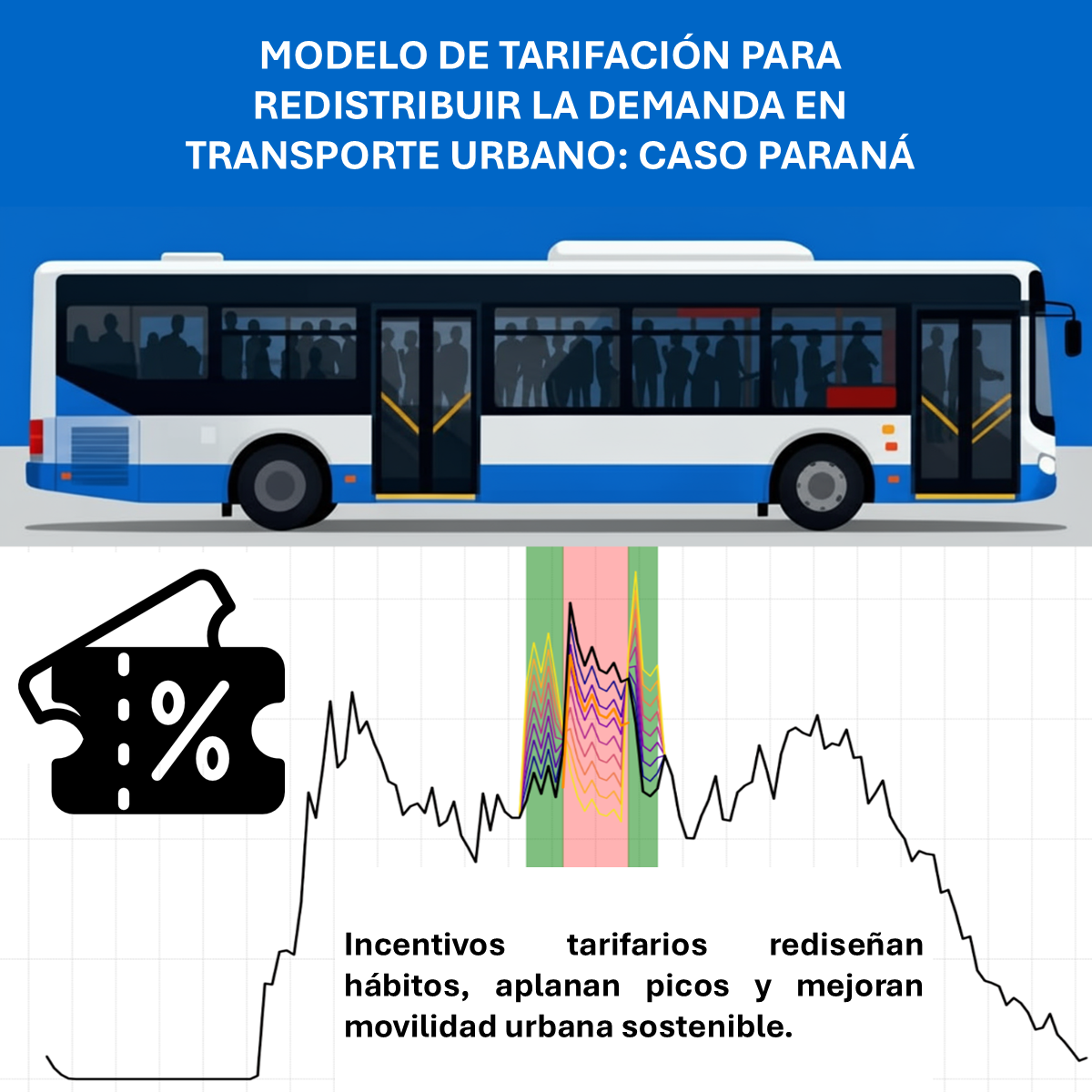
This study evaluates the impact of a mixed fare strategy on the public transport system in the city of Paraná, aiming to redistribute peak-hour demand through economic incentives. A quantitative methodology was applied, combining smartcard transaction data with user surveys and stochastic simulations using the Monte Carlo method. The results show that fare discounts of 30% and 40% significantly reduce passenger volumes during peak hours without generating new congestion periods. A segment of users with flexible travel schedules was identified as responsive to pricing incentives. The proposed strategy improves operational efficiency, reduces overcrowding, and optimizes resource allocation. These findings support the implementation of dynamic fare policies as a viable tool for demand management and service quality enhancement in intermediate cities.
Downloads
References
Albalate, D., & Fageda, X. (2019). Congestion, road safety, and the effectiveness of public policies in urban areas. Sustainability, 11(18), 5092. https://doi.org/10.3390/su11185092
Bosch, E., Luther, A. R., & Ihme, K. (2025). Travel experience in public transport: Experience sampling and cardiac activity data for spatial analysis. Scientific Data, 12, Article 633. https://doi.org/10.1038/s41597-025-04955-4
Broaddus, A., Litman, T., & Menon, G. (2009). Transportation demand management: Training document. Transportation in the New Millenium, 1-118. https://www.sutp.org/files/contents/documents/resources/H_Training-Material/GIZ_SUTP_TM_Transportation-Demand-Management_EN.pdf
Cervero, R. (1982). The transit pricing evaluation model: A tool for exploring fare policy options. Transportation Research Part A: General, 16(4), 313–323. https://doi.org/10.1016/0191-2607(82)90058-9
Cervero, R. (1998). The Transit Metropolis: A Global Inquiry. Island Press.
Ding, X., Hong, C., Wu, J., Zhao, L., Shi, G., Liu, Z., Hong, H., & Zhao, Z. (2023). Research on time-based fare discount strategy for urban rail transit peak congestion. Urban Rail Transit, 9(1), 352–367. https://doi.org/10.1007/s40864-023-00203-3
Drouet, L., Lallemand, C., Koenig, V., Viti, F., & Bongard-Blanchy, K. (2023). Uncovering factors influencing railway passenger experiences through love and breakup declarations. Applied Ergonomics, 111, Article 104030. https://doi.org/10.1016/j.apergo.2023.104030
Falavigna, C., & Hernandez, D. (2016). Assessing inequalities on public transport affordability in two Latin American cities: Montevideo (Uruguay) and Córdoba (Argentina). Transport Policy, 45, 145–155. https://doi.org/10.1016/j.tranpol.2015.09.011
Goodwin, P. B. (1992). A Review of New Demand Elasticities with Special Reference to Short and Long Run Effects of Price Changes. Journal of Transport Economics and Policy, 26(2), 155–169. http://www.jstor.org/stable/20052977
Guzmán, L. A., Gómez, S., & Moncada, C. A. (2020). Short run fare elasticities for Bogotá’s BRT system: Ridership responses to fare increases. Transportation, 47, 2581–2599. https://link.springer.com/article/10.1007/s11116-019-10034-6
Halvorsen, A., Koutsopoulos, H. N., Lau, S., Au, T., & Zhao, J. (2016). Reducing subway crowding: Analysis of an off-peak discount experiment in Hong Kong. Transportation Research Record, 2544(1), 38–46. https://doi.org/10.3141/2544-05
Jaurena, J. F., Diaz Arias, R. D., Franco, F., Lischet, S. M., & Hurani, R. A. (2022). Diseño de indicadores de gestión del transporte público de pasajeros a través de datos generados por el sistema SUBE: Caso de Estudio Ciudad Paraná. Ejes De Economía Y Sociedad. https://doi.org/10.33255/25914669/6109
Jaurena, J. F., Diaz Arias, R., Dorella, J., & Frattin, J. (2024). Estudio sobre Hábitos de Movilidad y Preferencias de Usuarios de Transporte Público de la Ciudad de Paraná (Entre Ríos). En XVII COINI 2024 – Congreso Internacional de Ingeniería Industrial – AACINI - UTN FRLP.
Jaurena, J. F., Díaz Arias, R., Elías, W., & Lambarri, J. (2023). Evaluación de la relación oferta-demanda en el sistema de transporte público de Paraná: Enfoque en la optimización y sostenibilidad de la movilidad. XVI COINI 2023 – Congreso Internacional de Ingeniería Industrial – AACINI - UTN FRSN.
Jaurena, J. F., Díaz Arias, R.; Alvarado, Mónica E.; Pagani, Laura B. (2025). Análisis de elasticidad precio de la demanda del transporte público en la ciudad de Paraná (2018-2024). Ejes De Economía Y Sociedad.
Liu, Y., & Charles, P. (2013). Spreading peak demand for urban rail transit through differential fare policy: a review of empirical evidence. En Australasian Transport Research Forum 2013 Proceedings (pp. 1–35). Australasian Transport Research Forum. https://eprints.qut.edu.au/65216/
MacLeod, KE, Kamruzzaman, L. y Musselwhite, C. (2022). Equidad en transporte y salud, inclusión y exclusión social. Journal of Transport & Health , 27 , 101543. https://doi.org/10.1016/j.jth.2022.101543
Nash, C. A. (1982). Economics of Public Transport. Longman.
Peer, S., Knockaert, J., & Verhoef, E. T. (2016). Train commuters’ scheduling preferences: Evidence from a large-scale peak avoidance experiment. Transportation Research Part B: Methodological, 83, 314–333. https://doi.org/10.1016/j.trb.2015.11.017
Saghian, Z., Esfahanipour, A., & Karimi, B. (2022). A novel dynamic fare pricing model based on fuzzy bi-level programming for subway systems with heterogeneous passengers. Computers & Industrial Engineering, 172, 108654. https://doi.org/10.1016/j.cie.2022.108654
UITP (International Association of Public Transport). (2017). Public Transport Trends 2017. Brussels: UITP. https://www.uitp.org/
Verbich, D., & El-Geneidy, A. (2017). Public transit fare structure and social vulnerability in Montreal, Canada. Transportation Research Part A: Policy and Practice, 96, 43–53. https://doi.org/10.1016/j.tra.2016.12.003
Vuchic, V. R. (2005). Urban Transit: Operations, Planning, and Economics. John Wiley & Sons.
Wang, Q., Schonfeld, P. M., Deng, L., Xu, G., & Ling, S. (2023). Optimization of differentiated fares and subsidies for different urban rail transit users. Computers & Industrial Engineering, 179, 109144. https://doi.org/10.1016/j.cie.2023.109144
Wang, Y., & Gao, Y. (2022). Travel satisfaction and travel well-being: Which is more related to travel choice behaviour in the post COVID-19 pandemic? Evidence from public transport travellers in Xi’an, China. Transportation Research Part A: Policy and Practice, 166, 218–233. https://doi.org/10.1016/j.tra.2022.10.003
White, P. R. (2016). Transporte público: su planificación, gestión y operación. Routledge. https://doi.org/10.4324/9781315675770
Xiao, L., Liao, J., Wu, S., Tian, Y., & Sun, J. (2024). Understanding the attitudes of travelers towards incentive-based travel demand management strategies in Suzhou, China. Travel Behaviour and Society, 35, 100752. https://doi.org/10.1016/j.tbs.2024.100752
Zhao, P., & Zhang, Y. (2019). The effects of metro fare increase on transport equity: New evidence from Beijing. Transport Policy, 74, 73–83. https://doi.org/10.1016/j.tranpol.2018.11.009
Downloads
Published
How to Cite
Issue
Section
License

This work is licensed under a Creative Commons Attribution-NonCommercial-ShareAlike 4.0 International License.