
Lubricación por aplastamiento en lesiones focales de cartílago
un análisis computacional
DOI:
https://doi.org/10.64876/radi.v26.2Palabras clave:
Lubricación por aplastamiento, Lesiones focales del cartílago, Modelado computacional, Microfracturas, Injerto osteocondralResumen
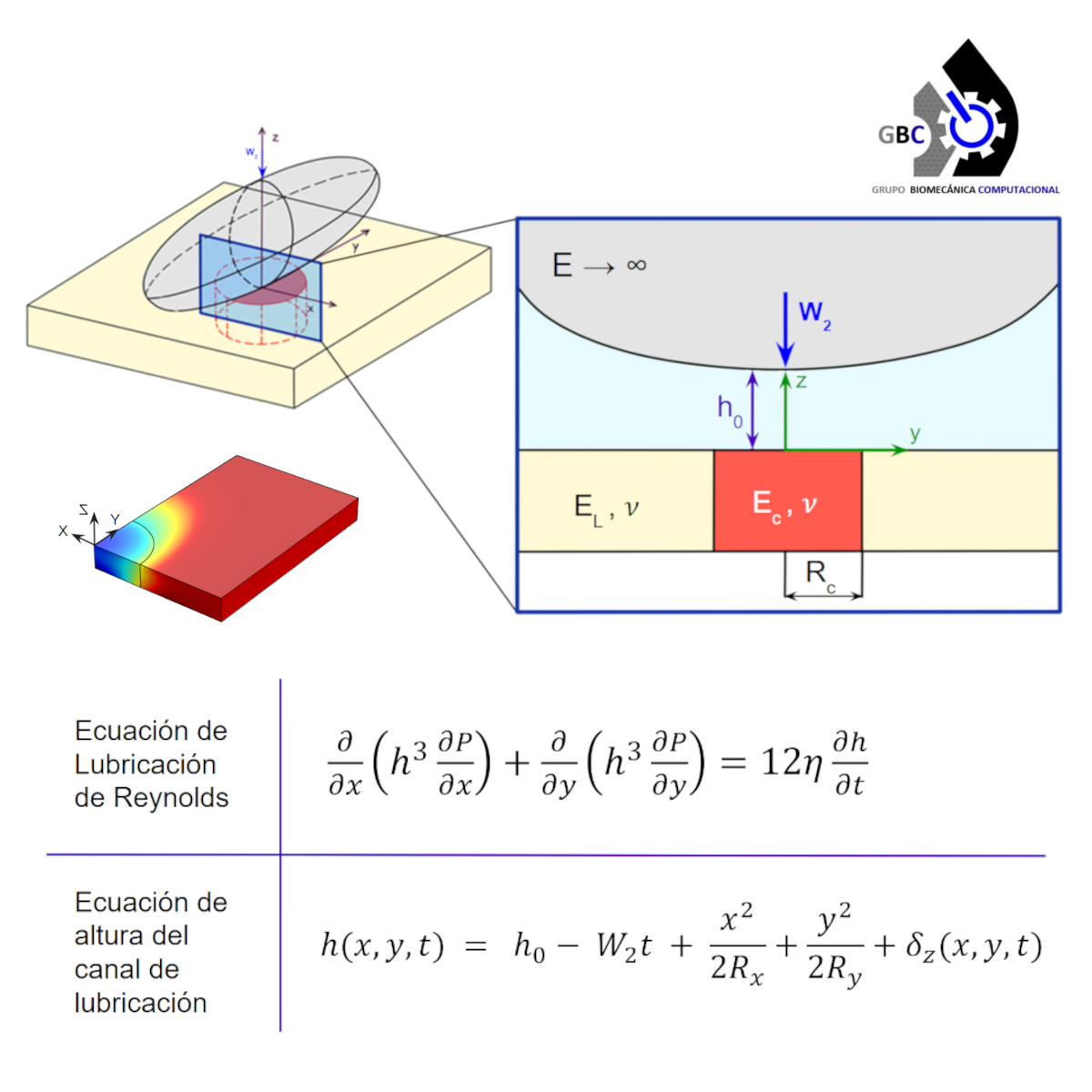
Las lesiones focales del cartílago articular son defectos localizados tratables con materiales de relleno que presentan propiedades mecánicas distintas a las del cartílago original. Este trabajo evalúa, mediante modelado y simulación, el efecto de dichos tratamientos sobre la lubricación articular. Se representa el cartílago con módulo elástico de 16 MPa y un defecto central tratado con material de módulo elástico variable (Ec, entre11,5 y 20,5 MPa). Utilizando COMSOL Multiphysics, se resolvieron las ecuaciones de lubricación de Reynolds y de elasticidad lineal. Los resultados muestran que la altura mínima del canal disminuye al aumentar o disminuir Ec respecto de 16 MPa, siendo el peor caso Ec = 20,5 MPa, donde se predice un régimen mixto de lubricación, que favorecería el desgaste del cartílago. En síntesis, los resultados orientan la elección de materiales de relleno con módulo elástico inferior a 20,5 MPa y lo más cercano posible al del cartílago.
Descargas
Citas
Berli, M.E. (2010). Solución numérica de un modelo de lubricación visco-elastohidrodinámica de prótesis de rodilla. Tesis de Magíster en Tecnología Química, Universidad Nacional del Litoral. Biblioteca Virtual de la UNL. https://bibliotecavirtual.unl.edu.ar:8443/handle/11185/424
DeFroda, S. F., Bokshan, S. L., Yang, D. S., Daniels, A. H., & Owens, B. D. (2021). Trends in the surgical treatment of articular cartilage lesions in the United States from 2007 to 2016. Journal of Knee Surgery, 34(14), 1609–1616. https://doi.org/10.1055/s-0040-1712946
Di Paolo, J., &Berli, M. E. (2006). Numerical analysis of the effects of material parameters on the lubrication mechanism for knee prosthesis. Computer Methods in Biomechanics and Biomedical Engineering, 9(2), 79-89. https://doi.org/10.1080/10255840500523139
Di Puccio, F., & Mattei, L. (2015). Biotribology of artificial hip joints. World Journal of Orthopedics, 6(1), 77-94.https://doi.org/10.5312/wjo.v6.i1.77
Fish, J., & Belytschko, T. (2007). A first course in finite elements. Wiley. https://doi.org/10.1002/9780470510858
Forriol Campos, F. (2002). El cartílago articular: Aspectos mecánicos y su repercusión en la reparación tisular.Revista Española de Cirugía Ortopédica y Traumatología, 46(5), 380–390. Recuperado de https://www.elsevier.es/es-revista-revista-espanola-cirugia-ortopedica-traumatologia-129-pdf-13038046
Hamsayeh Abbasi Niasar, E., & Li, L. P. (2023). Characterizing site-specific mechanical properties of knee cartilage with indentation-relaxation maps and machine learning. Journal of the Mechanical Behavior of Biomedical Materials, 142, 105826. https://doi.org/10.1016/j.jmbbm.2023.105826
Hashemi, S., Amani, A. M., Abbasi, M., & Golchin, A. (2024). Development of three-dimensional printed biocompatible materials for cartilage replacement. En A. R. Nochehdehi, F. Nemavhola, S. Thomas, & H. J. Maria (Eds.), Cartilage tissue and knee joint biomechanics (pp. 425–452). Elsevier. https://doi.org/10.1016/B978-0-323-90597-8.00015-3
Hinckel, B. B., Thomas, D., Vellios, E. E., Hancock, K. J., Calcei, J. G., Sherman, S. L., Eliasberg, C. D., Fernandes, T. L., Farr, J., Lattermann, C., & Gomoll, A. H. (2021). Algorithm for treatment of focal cartilage defects of the knee: Classic and new procedures. Cartilage, 13(1 Suppl), 473S–495S. https://doi.org/10.1177/1947603521993219
Jin, Z., Yang, P., Cui, J., & Dowson, D. (2004). Transient elastohydrodynamic analysis of elliptical contacts. Proceedings of the Institution of Mechanical Engineers, Part J: Journal of Engineering Tribology, 218(3), 211-224. https://doi.org/10.1243/1350650041323403
Jin, Z. M., Dowson, D., & Fisher, J. (1995). Contact pressure prediction in total knee joint replacements. Part 1: General elasticity solution for elliptical layered contacts. Proceedings of the Institution of Mechanical Engineers, Part H: Journal of Engineering in Medicine, 209(1), 1–8. https://doi.org/10.1243/PIME_PROC_1995_209_311_02
Kraeutler, M. J., Kaenkumchorn, T., Pascual-Garrido, C., Wimmer, M. A., & Chubinskaya, S. (2017). Peculiarities in ankle cartilage. Cartilage, 8(1), 12–18. https://doi.org/10.1177/1947603516642572
Krakowski, P., Rejniak, A., Sobczyk, J., & Karpiński, R. (2024). Cartilage integrity: A review of mechanical and frictional properties and repair approaches in osteoarthritis. Healthcare, 12(16), 1648. https://doi.org/10.3390/healthcare12161648
Kutaish, H., Klopfenstein, A., Obeid Adorisio, S. N., Tscholl, P. M., &Fucentese, S. (2025). Current trends in the treatment of focal cartilage lesions: A comprehensive review. EFORT Open Reviews, 10(4), 203–212. https://doi.org/10.1530/EOR-2024-0083
Athanasiou, K. A., Darling, E. M., Hu, J. C., DuRaine, G. D., & Reddi, A. H. (2017). Articular cartilage (2.ª ed.). CRC Press. https://doi.org/10.1201/9781315194158
Lawrence, R. C., Felson, D. T., Helmick, C. G., Arnold, L. M., Choi, H., Deyo, R. A., Gabriel, S., Hirsch, R., Hochberg, M. C., Hunder, G. G., Jordan, J. M., Katz, J. N., Kremers, H. M., & Wolfe, F.; National Arthritis Data Workgroup. (2008). Estimates of the prevalence of arthritis and other rheumatic conditions in the United States. Part II. Arthritis & Rheumatism, 58(1), 26–35. https://doi.org/10.1002/art.23176
Loening, A. M., James, I. E., Levenston, M. E., Badger, A. M., Frank, E. H., Kurz, B., Nuttall, M. E., Hung, H.-H., Blake, S. M., Grodzinsky, A. J., & Lark, M. W. (2000). Injurious mechanical compression of bovine articular cartilage induces chondrocyte apoptosis. Archives of Biochemistry and Biophysics, 381(2), 205–212. https://doi.org/10.1006/abbi.2000.1988
Long, H., Liu, Q., Yin, H., Wang, K., Diao, N., Zhang, Y., Lin, J., & Guo, A. (2022). Prevalence trends of site-specific osteoarthritis from 1990 to 2019: Findings from the Global Burden of Disease Study 2019. Arthritis&Rheumatology, 74(7), 1172–1183. https://doi.org/10.1002/art.42089
Majtj, D. (2021). Chondral Lesions of the Knee:An Evidence-Based Approach. 103(7).
Mansour, J.M. (2013). Biomechanics of cartilage.
McCormick, F., Harris, J. D., Abrams, G. D., Frank, R., Gupta, A., Hussey, K., Wilson, H., Bach, B. Jr., & Cole, B. (2014). Trends in the surgical treatment of articular cartilage lesions in the United States: An analysis of a large private-payer database over a period of 8 years. Arthroscopy, 30(2), 222–226. https://doi.org/10.1016/j.arthro.2013.11.001
Minas, T. (2011). Patient evaluation, cartilage defect, and evidence: Putting it all together. En T. Minas (Ed.), A primer in cartilage repair and joint preservation of the knee (pp. 31–46). Elsevier.
Mostakhdemin, M., Nand, A., & Ramezani, M. (2021). Articular and Artificial Cartilage, Characteristics, Properties and Testing Approaches—A Review. Polymers, 13(12), 2000.https://doi.org/10.3390/polym13122000
Petitjean, N., Canadas, P., Royer, P., Noël, D., & Le Floc’h, S. (2023). Cartilage biomechanics: From the basic facts to the challenges of tissue engineering. Journal of Biomedical Materials Research Part A, 111(7). https://doi.org/10.1002/jbm.a.37478
Richter, D. L., Schenck, R. C. Jr., Wascher, D. C., & Treme, G. (2016). Knee articular cartilage repair and restoration techniques: A review of the literature. Sports Health, 8(2), 153–160. https://doi.org/10.1177/1941738115611350
Seedhom, B. B., & Shepherd, D. E. T. (1999). Thickness of human articular cartilage in joints of the lower limb. Annals of the Rheumatic Diseases, 58(1), 27–34. https://doi.org/10.1136/ard.58.1.27
Seedhom, B. B., Longton, E. B., Wright, V., & Dowson, D. (1972). Dimensions of the knee. Radiographic and autopsy study of sizes required by a knee prosthesis. Annals of the Rheumatic Diseases, 31(1), 54-58. https://doi.org/10.1136/ard.31.1.54
Sociedad Argentina de Reumatología (2010). Guías Argentinas de Práctica Clínica para el Diagnóstico y Tratamiento de la Osteoartritis (pp. 3–5).
Su, Y., Wang, L., Greenberg, R. K., & Pedersen, D. R. (2011). Time-dependent elastohydrodynamic lubrication analysis of total knee replacement under walking conditions. Computer Methods in Biomechanics and Biomedical Engineering, 14(6), 539–548. https://doi.org/10.1080/10255842.2010.524272
Vanwanseele, B., Jessica, P., Susan, C., & Mark, R. (2002). The effects of immobilization on the characteristics of articular cartilage: Current concepts and future directions. Osteoarthritis and Cartilage, 10(5).
Venäläinen, M. S., Mononen, M. E., Salo, J., Räsänen, L. P., Jurvelin, J. S., Töyräs, J., Virén, T., &Korhonen, R. K. (2016). Quantitative evaluation of the mechanical risks caused by focal cartilage defects in the knee. Scientific Reports, 6(1), 37538. https://doi.org/10.1038/srep37538
Wallace, I. J., Worthington, S., Felson, D. T., Jurmain, R. D., Wren, K. T., Maijanen, H., Woods, R. J., & Lieberman, D. E. (2017). Knee osteoarthritis has doubled in prevalence since the mid-20th century. Proceedings of the National Academy of Sciences of the United States of America, 114(35), 9332–9336. https://doi.org/10.1073/pnas.1703856114
Weiss, B. A., Bou-Saïd, B., Ubal, S., & Di Paolo, J. (2019). The Phan-Thien and Tanner model applied to the lubrication of knee prostheses. Journal of Biomechanical Engineering, 141(8), 081008. https://doi.org/10.1115/1.4043032
Weiss, B. A. (2022). Articulaciones sinoviales artificiales de alta movilidad: Investigaciones para el desarrollo de prótesis de por vida [Tesis doctoral].
Descargas
Publicado
Cómo citar
Número
Sección
Licencia

Esta obra está bajo una licencia internacional Creative Commons Atribución-NoComercial-CompartirIgual 4.0.